Principal Risks include: Currency, ETF, Equity Securities, Foreign Securities, Loss of Money, MLP, Management, Not FDIC Insured, Other, Real Estate/REIT Sector and Small Cap. See disclosure for details.
Currency Investments in securities traded in foreign currencies or more directly in foreign currencies are subject to the risk that the foreign currency will decline in value relative to the U.S. dollar, which may reduce the value of the portfolio. Investments in currency hedging positions are subject to the risk that the value of the U.S. dollar will decline relative to the currency being hedged, which may result in a loss of money on the investment as well as the position designed to act as a hedge. Cross-currency hedging strategies and active currency positions may increase currency risk because actual currency exposure may be substantially different from that suggested by the portfolio's holdings.
ETF Investments in exchange-traded funds generally reflect the risks of owning the underlying securities they are designed to track, although they may be subject to greater liquidity risk and higher costs than owning the underlying securities directly because of their management fees. Shares of ETFs are subject to market trading risk, potentially trading at a premium or discount to net asset value.
Equity Securities The value of equity securities, which include common, preferred, and convertible preferred stocks, will fluctuate based on changes in their issuers' financial conditions, as well as overall market and economic conditions, and can decline in the event of deteriorating issuer, market, or economic conditions.
Foreign Securities Investments in foreign securities may be subject to increased volatility as the value of these securities can change more rapidly and extremely than can the value of U.S. securities. Foreign securities are subject to increased issuer risk because foreign issuers may not experience the same degree of regulation as U.S. issuers do and are held to different reporting, accounting, and auditing standards. In addition, foreign securities are subject to increased costs because there are generally higher commission rates on transactions, transfer taxes, higher custodial costs, and the potential for foreign tax charges on dividend and interest payments. Many foreign markets are relatively small, and securities issued in less-developed countries face the risks of nationalization, expropriation or confiscatory taxation, and adverse changes in investment or exchange control regulations, including suspension of the ability to transfer currency from a country. Economic, political, social, or diplomatic developments can also negatively impact performance.
Loss of Money Because the investment's market value may fluctuate up and down, an investor may lose money, including part of the principal, when he or she buys or sells the investment.
MLP Investments in master limited partnerships may be subject to the risk that their value is reduced because of poor performance of the underlying assets or if they are not treated as partnerships for federal income tax purposes. Investors in MLPs have more-limited control and voting rights on matters affecting the partnership compared with shareholders of common stock.
Management Performance is subject to the risk that the advisor's asset allocation and investment strategies do not perform as expected, which may cause the portfolio to underperform its benchmark, other investments with similar objectives, or the market in general. The investment is subject to the risk of loss of income and capital invested, and the advisor does not guarantee its value, performance, or any particular rate of return.
Not FDIC Insured The investment is not a deposit or obligation of, or guaranteed or endorsed by, any bank and is not insured by the Federal Deposit Insurance Corporation, the Federal Reserve Board, or any other U.S. governmental agency.
Other The investment's performance may be impacted by its concentration in a certain type of security, adherence to a particular investing strategy, or a unique aspect of its structure and costs.
Real Estate/REIT Sector Concentrating assets in the real estate sector or REITs may disproportionately subject the portfolio to the risks of that industry, including loss of value because of changes in real estate values, interest rates, and taxes, as well as changes in zoning, building, environmental, and other laws, among other factors. Investments in REITs may be subject to increased price volatility and liquidity risk, and shareholders indirectly bear their proportionate share of expenses because of their management fees.
Small Cap Concentrating assets in small-capitalization stocks may subject the portfolio to the risk that those stocks underperform other capitalizations or the market as a whole. Smaller, less-seasoned companies may be subject to increased liquidity risk compared with mid- and large-cap companies and may experience greater price volatility than do those securities because of limited product lines, management experience, market share, or financial resources, among other factors.
Other:
b2. The portfolio composition, industry sectors, top ten holdings, and credit analysis are presented to illustrate examples of securities that the fund has bought and diversity of areas in which the fund may invest and may not be representative of the fund's current or future investments. The top ten holdings do not include money market instruments and/or futures contracts. The figures presented are as of date shown, do not include the fund's entire investment portfolio, and may change at any time.
b33. Small Blend Average is the average annual total return of the universe of mutual funds designated by Morningstar, Inc. as comprising the Morningstar Small Blend category.
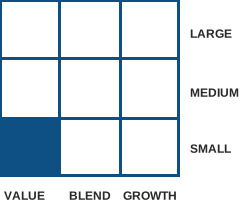
Fund data, Style Box and Morningstar Portfolio Ratings All Morningstar data is © 2017 by Morningstar, Inc. All rights reserved. The information contained herein: (1) is proprietary to Morningstar and/or its content providers; (2) may not be copied or distributed; and (3) is not warranted to be accurate, complete or timely. Neither Morningstar nor its content providers are responsible for any damages or losses arising from any use of this information.
f1. The Gross Expense Ratio does not include fee waivers or expense reimbursements which result in lower actual cost to the investor. The Net Expense Ratio represents the effect of a fee waiver and/or expense reimbursement and is subject to change.
Marketing support services are provided by John Hancock Distributors LLC.
Index Description:
i22. Russell 2000 Value Index: The Russell 2000 Value Index is an unmanaged index that measures the performance of those Russell 2000 companies with lower price-to-book ratios and lower forecasted growth values. Results assume the reinvestment of all capital gain and dividend distributions. An investment cannot be made directly into an index.
Morningstar Category Description:
c31. Small-blend portfolios favor U.S. firms at the smaller end of the market-capitalization range. Some aim to own an array of value and growth stocks while others employ a discipline that leads to holdings with valuations and growth rates close to the small-cap averages. Stocks in the bottom 10% of the capitalization of the U.S. equity market are defined as small cap. The blend style is assigned to portfolios where neither growth nor value characteristics predominate.
A fund's investment objectives, risks, charges and expenses should be considered carefully before investing. The prospectus contains this and other important information about the fund. To obtain a prospectus, contact John Hancock Retirement Plan Services, LLC at (800) 294-3575 or visit our website at myplan.johnhancock.com. Please read the prospectus carefully before investing or sending money.


 PRINTABLE