
The investment seeks a high and stable rate of current income, consistent with long-term preservation of capital; a secondary objective is capital appreciation. The fund invests in a diversified portfolio of bonds and other debt securities. The fund will invest at least 80% of its total assets in (1) investment-grade debt securities and (2) cash equivalents. "Investment grade" means securities rated Baa3 or higher by Moody's Investors Service, or BBB- or higher by Standard & Poor's Ratings Group or Fitch Ratings, or equivalently rated by any nationally recognized statistical rating organization, or, if unrated, deemed to be of similar quality by Dodge & Cox.
| Ticker | DODIX |
| Inception Date | 1989-01-03 |
| Gross Expense Ratiof1 (%) | 0.41 |
| Net Expense Ratiof1 (%) | 0.41 |
| Fund Total Net Assets ($M) | 84,859.00 |
| Management Company | Dodge & Cox |
| Portfolio Managers | Anthony J. Brekke Adam S. Rubinson Lucinda I. Johns Michael Kiedel Nils M. Reuter |
| Management Company Contact | 800-621-3979 |
% of Assets
| Federal Home Loan Mortgage Corp. | 2.79 |
| United States Treasury Bonds | 1.80 |
| United States Treasury Bonds | 1.55 |
| Federal Home Loan Mortgage Corp. | 1.46 |
| United States Treasury Notes | 1.32 |
| United States Treasury Notes | 1.25 |
| Federal Home Loan Mortgage Corp. | 1.19 |
| Federal National Mortgage Association | 1.12 |
| United States Treasury Bonds | 0.93 |
| Federal Home Loan Mortgage Corp. | 0.88 |
| YTD | 1 Year | 3 Year | 5 Year | 10 Year | Since |
|
|---|---|---|---|---|---|---|
| Dodge & Cox Income Fund | 0.04 | 5.34 | 4.99 | 1.58 | 3.11 | -- |
| Bloomberg US Aggregate Bond Ini30 | -0.05 | 4.35 | 3.63 | 0.31 | 1.70 | -- |
| Intermediate Core-Plus Bondb87 | -0.18 | 4.51 | 4.29 | 0.70 | 2.30 | -- |
| Performance data quoted represents past performance. Past performance is no guarantee of future results. Due to market volatility, current performance may be less or higher than the figures shown. Investment return and principal value will fluctuate so that upon redemption, shares may be worth more or less than their original cost. Performance data does not reflect deduction of redemption fee, which, if such fee exists, would lower performance. For current to the most recent month-end performance information, please log onto myplan.johnhancock.com or call a John Hancock representative at (800) 294-3575. | ||||||
| Long % | Short % | Net % |
|---|
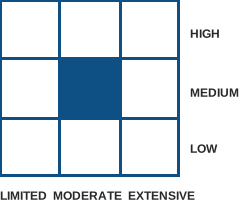
Intermediate-term core-plus bond portfolios invest primarily in investment-grade U.S. fixed-income issues including government, corporate, and securitized debt, but generally have greater flexibility than core offerings to hold non-core sectors such as corporate high yield, bank loan, emerging-markets debt, and non-U.S. currency exposures. Their durations (a measure of interest-rate sensitivity) typically range between 75% and 125% of the three-year average of the effective duration of the Morningstar Core Bond Index.
Out of 496 funds

Out of 496 funds

Out of 455 funds
Out of 355 funds
m1. For each fund with at least a three-year history, Morningstar calculates a Morningstar RatingTM based on a Morningstar Risk-Adjusted Return measure that accounts for variation in a fund's monthly performance(not including the effects of sales charges, loads, and redemption fees), placing more emphasis on downward variations and rewarding consistent performance. Exchange traded funds and open-ended mutual funds are considered a single population for comparative purposes. The top 10% of funds in each category receive five stars, then next 22.5% receive four stars, the middle 35% receive three stars, the next 22.5% receive two stars, and the bottom 10% receive one star. The Overall Morningstar RatingTM for a fund is derived from a weighted average of the performance figures associated with its three-, five- and 10-year (if applicable) Morningstar RatingTM metrics. The rating formula most heavily weights the three year rating, using the following calculation: 100% three-year rating for 36-59 months of total returns, 60% five-year rating/40% three-year rating for 60-119 months of total returns, and 50% 10-year rating/30% five-year rating/20% three-year rating for 120 or more months of total returns. Past performance does not guarantee future results.
| Turnover Ratio (%) (annualized) | 18 |
| Betab1 (3y) (Bloomberg US Agg Bond TR USD) | 1.05 |
| R-squaredb53 (%) (3y) (Bloomberg US Agg Bond TR USD) | 99.02 |
| Sharpe Ratiob54 (3y) | 0.04 |
| # of Stock Holdings | 0 |
| # of Bond Holdings | 1543 |
| Best 2-month Period | Nov. 23 - Jan. 24 | 9.08 |
| Worst 2-month Period | Aug. 22 - Oct. 22 | -7.38 |

This investment has shown a relatively small range of price fluctuations in the past. Based on this measure, currently more than two thirds of all mutual funds with three-year histories have shown higher levels of risk.
 PRINTABLE