Principal Risks include: Commodity, Conflict of Interest, Convertible Securities, Credit and Counterparty, Derivatives, ETF, ETN, Equity Securities, Fixed-Income Securities, Foreign Securities, Hedging Strategies, High-Yield Securities, IPO, Industry and Sector Investing, Large Cap, Loss of Money, Management, Market/Market Volatility, Mid-Cap, Mortgage-Backed and Asset-Backed Securities, Nondiversification, Not FDIC Insured, Other, Preferred Stocks, Restricted/Illiquid Securities, Short Sale, Small Cap, Socially Conscious and Underlying Fund/Fund of Funds. See disclosure for details.
Commodity Investments in commodity-related instruments are subject to the risk that the performance of the overall commodities market declines and that weather, disease, political, tax, and other regulatory developments adversely impact the value of commodities, which may result in a loss of principal and interest. Commodity-linked investments face increased price volatility and liquidity, credit, and issuer risks compared with their underlying measures.
Conflict of Interest A conflict of interest may arise if the advisor makes an investment in certain underlying funds based on the fact that those funds are also managed by the advisor or an affiliate or because certain underlying funds may pay higher fees to the advisor do than others. In addition, an advisor's participation in the primary or secondary market for loans may be deemed a conflict of interest and limit the ability of the investment to acquire those assets.
Convertible Securities Investments in convertible securities may be subject to increased interest-rate risks, rising in value as interest rates decline and falling in value when interest rates rise, in addition to their market value depending on the performance of the common stock of the issuer. Convertible securities, which are typically unrated or rated lower than other debt obligations, are secondary to debt obligations in order of priority during a liquidation in the event the issuer defaults.
Credit and Counterparty The issuer or guarantor of a fixed-income security, counterparty to an OTC derivatives contract, or other borrower may not be able to make timely principal, interest, or settlement payments on an obligation. In this event, the issuer of a fixed-income security may have its credit rating downgraded or defaulted, which may reduce the potential for income and value of the portfolio.
Derivatives Investments in derivatives may be subject to the risk that the advisor does not correctly predict the movement of the underlying security, interest rate, market index, or other financial asset, or that the value of the derivative does not correlate perfectly with either the overall market or the underlying asset from which the derivative's value is derived. Because derivatives usually involve a small investment relative to the magnitude of liquidity and other risks assumed, the resulting gain or loss from the transaction will be disproportionately magnified. These investments may result in a loss if the counterparty to the transaction does not perform as promised.
ETF Investments in exchange-traded funds generally reflect the risks of owning the underlying securities they are designed to track, although they may be subject to greater liquidity risk and higher costs than owning the underlying securities directly because of their management fees. Shares of ETFs are subject to market trading risk, potentially trading at a premium or discount to net asset value.
ETN Investments in exchange-traded notes may be subject to the risk that their value is reduced because of poor performance of the underlying index or a downgrade in the issuer's credit rating, potentially resulting in default. The value of these securities may also be impacted by time to maturity, level of supply and demand, and volatility and lack of liquidity in underlying markets, among other factors. The portfolio bears its proportionate share of fees and expenses associated with investment in ETNs, and its decision to sell these holdings may be limited by the availability of a secondary market.
Equity Securities The value of equity securities, which include common, preferred, and convertible preferred stocks, will fluctuate based on changes in their issuers' financial conditions, as well as overall market and economic conditions, and can decline in the event of deteriorating issuer, market, or economic conditions.
Fixed-Income Securities The value of fixed-income or debt securities may be susceptible to general movements in the bond market and are subject to interest-rate and credit risk.
Foreign Securities Investments in foreign securities may be subject to increased volatility as the value of these securities can change more rapidly and extremely than can the value of U.S. securities. Foreign securities are subject to increased issuer risk because foreign issuers may not experience the same degree of regulation as U.S. issuers do and are held to different reporting, accounting, and auditing standards. In addition, foreign securities are subject to increased costs because there are generally higher commission rates on transactions, transfer taxes, higher custodial costs, and the potential for foreign tax charges on dividend and interest payments. Many foreign markets are relatively small, and securities issued in less-developed countries face the risks of nationalization, expropriation or confiscatory taxation, and adverse changes in investment or exchange control regulations, including suspension of the ability to transfer currency from a country. Economic, political, social, or diplomatic developments can also negatively impact performance.
Hedging Strategies The advisor's use of hedging strategies to reduce risk may limit the opportunity for gains compared with unhedged investments, and there is no guarantee that hedges will actually reduce risk.
High-Yield Securities Investments in below-investment-grade debt securities and unrated securities of similar credit quality, commonly known as "junk bonds" or "high-yield securities," may be subject to increased interest, credit, and liquidity risks.
IPO Investing in initial public offerings may increase volatility and have a magnified impact on performance. IPO shares may be sold shortly after purchase, which can increase portfolio turnover and expenses, including commissions and transaction costs. Additionally, IPO shares are subject to increased market, liquidity, and issuer risks.
Industry and Sector Investing Concentrating assets in a particular industry, sector of the economy, or markets may increase volatility because the investment will be more susceptible to the impact of market, economic, regulatory, and other factors affecting that industry or sector compared with a more broadly diversified asset allocation.
Large Cap Concentrating assets in large-capitalization stocks may subject the portfolio to the risk that those stocks underperform other capitalizations or the market as a whole. Large-cap companies may be unable to respond as quickly as small- and mid-cap companies can to new competitive pressures and may lack the growth potential of those securities. Historically, large-cap companies do not recover as quickly as smaller companies do from market declines.
Loss of Money Because the investment's market value may fluctuate up and down, an investor may lose money, including part of the principal, when he or she buys or sells the investment.
Management Performance is subject to the risk that the advisor's asset allocation and investment strategies do not perform as expected, which may cause the portfolio to underperform its benchmark, other investments with similar objectives, or the market in general. The investment is subject to the risk of loss of income and capital invested, and the advisor does not guarantee its value, performance, or any particular rate of return.
Market/Market Volatility The market value of the portfolio's securities may fall rapidly or unpredictably because of changing economic, political, or market conditions, which may reduce the value of the portfolio.
Mid-Cap Concentrating assets in mid-capitalization stocks may subject the portfolio to the risk that those stocks underperform other capitalizations or the market as a whole. Mid-cap companies may be subject to increased liquidity risk compared with large-cap companies and may experience greater price volatility than do those securities because of more-limited product lines or financial resources, among other factors.
Mortgage-Backed and Asset-Backed Securities Investments in mortgage-backed and asset-backed securities may be subject to increased price volatility because of changes in interest rates, issuer information availability, credit quality of the underlying assets, market perception of the issuer, availability of credit enhancement, and prepayment of principal. The value of ABS and MBS may be adversely affected if the underlying borrower fails to pay the loan included in the security.
Nondiversification A nondiversified investment, as defined under the Investment Act of 1940, may have an increased potential for loss because its portfolio includes a relatively small number of investments. Movements in the prices of the individual assets may have a magnified effect on a nondiversified portfolio. Any sale of the investment's large positions could adversely affect stock prices if those positions represent a significant part of a company's outstanding stock.
Not FDIC Insured The investment is not a deposit or obligation of, or guaranteed or endorsed by, any bank and is not insured by the Federal Deposit Insurance Corporation, the Federal Reserve Board, or any other U.S. governmental agency.
Other The investment's performance may be impacted by its concentration in a certain type of security, adherence to a particular investing strategy, or a unique aspect of its structure and costs.
Preferred Stocks Investments in preferred stocks may be subject to the risks of deferred distribution payments, involuntary redemptions, subordination to debt instruments, a lack of liquidity compared with common stocks, limited voting rights, and sensitivity to interest-rate changes.
Restricted/Illiquid Securities Restricted and illiquid securities may fall in price because of an inability to sell the securities when desired. Investing in restricted securities may subject the portfolio to higher costs and liquidity risk.
Short Sale Selling securities short may be subject to the risk that an advisor does not correctly predict the movement of the security, resulting in a loss if a security must be purchased on the market above its initial borrowing price to return to the lender, in addition to interest paid to the lender for borrowing the security.
Small Cap Concentrating assets in small-capitalization stocks may subject the portfolio to the risk that those stocks underperform other capitalizations or the market as a whole. Smaller, less-seasoned companies may be subject to increased liquidity risk compared with mid- and large-cap companies and may experience greater price volatility than do those securities because of limited product lines, management experience, market share, or financial resources, among other factors.
Socially Conscious Adhering to social, moral, or environmental criteria may preclude potentially profitable opportunities in sectors or firms that would otherwise be consistent with the investment objective and strategy.
Underlying Fund/Fund of Funds A portfolio's risks are closely associated with the risks of the securities and other investments held by the underlying or subsidiary funds, and the ability of the portfolio to meet its investment objective likewise depends on the ability of the underlying funds to meet their objectives. Investment in other funds may subject the portfolio to higher costs than owning the underlying securities directly because of their management fees.
Other:
b2. The portfolio composition, industry sectors, top ten holdings, and credit analysis are presented to illustrate examples of securities that the fund has bought and diversity of areas in which the fund may invest and may not be representative of the fund's current or future investments. The top ten holdings do not include money market instruments and/or futures contracts. The figures presented are as of date shown, do not include the fund's entire investment portfolio, and may change at any time.
b54. Sharpe ratio is a measure of excess return per unit of risk, as defined by standard deviation. A higher Sharpe ratio suggests better risk-adjusted performance.
b109. Global Aggressive Allocation Average is the average annual total return of the universe of mutual funds designated by Morningstar, Inc. as comprising the Morningstar Global Aggressive Allocation category.
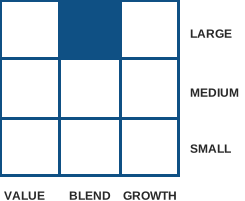
Fund data, Style Box and Morningstar Portfolio Ratings All Morningstar data is © 2017 by Morningstar, Inc. All rights reserved. The information contained herein: (1) is proprietary to Morningstar and/or its content providers; (2) may not be copied or distributed; and (3) is not warranted to be accurate, complete or timely. Neither Morningstar nor its content providers are responsible for any damages or losses arising from any use of this information.
f1. The Gross Expense Ratio does not include fee waivers or expense reimbursements which result in lower actual cost to the investor. The Net Expense Ratio represents the effect of a fee waiver and/or expense reimbursement and is subject to change.
In addition to fees charged by JHRPS for its services to the plan, affiliates of JHRPS receive investment management and other fees from the John Hancock Funds and other funds advised or sub-advised by JHRPS's affiliates.
Marketing support services are provided by John Hancock Distributors LLC.
Index Description:
i83. The Morningstar Aggressive Index represents a portfolio of global equities, bonds and traditional inflation hedges such as commodities and TIPS. This portfolio is held in a static allocation appropriate for U.S. investors who seek above-average exposure to equity market risk and returns. An investment cannot be made directly into an index.
Morningstar Category Description:
c124. Funds in allocation categories seek to provide both income and capital appreciation by primarily investing in multiple asset classes, including stocks, bonds, and cash. These aggressive strategies typically prioritize capital appreciation over preservation. They typically expect volatility similar to a strategic equity exposure of more than 85%. Funds in this global category are generally expected to have no more than 75% of their assets in US securities.
A fund's investment objectives, risks, charges and expenses should be considered carefully before investing. The prospectus contains this and other important information about the fund. To obtain a prospectus, contact John Hancock Retirement Plan Services LLC at (800) 294-3575 or visit our website at myplan.johnhancock.com. Please read the prospectus carefully before investing or sending money.



 PRINTABLE