
The investment seeks capital appreciation and some current income. The fund invests in a mix of Vanguard mutual funds according to an asset-allocation strategy that reflects an allocation of approximately 20% of the fund’s assets to fixed-income securities and 80% to common stocks. The fund’s indirect fixed-income holdings are a diversified mix of short-, intermediate-, and long-term U.S. government, U.S. agency, and investment-grade U.S. corporate bonds; mortgage-backed and asset-backed securities; and government, agency, corporate, and securitized investment-grade foreign bonds issued in currencies other than the U.S. dollar.
| Ticker | VASGX |
| Inception Date | 1994-09-30 |
| Gross Expense Ratiof1 (%) | 0.10 |
| Net Expense Ratiof1 (%) | 0.10 |
| Fund Total Net Assets ($M) | 27,284.87 |
| Management Company | Vanguard Group, Inc. (via Vanguard Capit |
| Portfolio Managers | Michael R. Roach Walter Nejman Aurélie Denis Roger Aliaga-Diaz |
| Management Company Contact | 800-662-7447 |
| Blackout Holding Period (Days) | 30 |
| Blackout Minimum Amount ($) | 50,000.00 |
% of Assets
| Vanguard MStar Total Stk Mkt Idx Invest | 48.58 |
| Vanguard Total Intl Stock Index Inv | 32.88 |
| Vanguard Total Bond Market II Idx Inv | 12.72 |
| Vanguard Total Intl Bd II Idx Investor | 5.23 |
| YTD | 1 Year | 3 Year | 5 Year | 10 Year | Since |
|
|---|---|---|---|---|---|---|
| Vanguard LifeStrategy 80/20 Fund | 9.89 | 12.96 | 17.97 | 8.96 | 10.27 | -- |
| Morningstar Moderately Aggr Tai82 | 8.85 | 11.44 | 16.35 | 7.87 | 9.60 | -- |
| Global Moderately Aggressive Allocationb111 | 9.04 | 11.78 | 16.45 | 8.11 | 8.99 | -- |
| Performance data quoted represents past performance. Past performance is no guarantee of future results. Due to market volatility, current performance may be less or higher than the figures shown. Investment return and principal value will fluctuate so that upon redemption, shares may be worth more or less than their original cost. Performance data does not reflect deduction of redemption fee, which, if such fee exists, would lower performance. For current to the most recent month-end performance information, please log onto myplan.johnhancock.com or call a John Hancock representative at (800) 294-3575. | ||||||
| Long % | Short % | Net % |
|---|
Funds in allocation categories seek to provide both income and capital appreciation by primarily investing in multiple asset classes, including stocks, bonds, and cash. These moderately aggressive strategies prioritize capital appreciation over preservation. They typically expect volatility similar to a strategic equity exposure between 70% and 85%. Funds in this global category are generally expected to have no more than 75% of their assets in US securities.
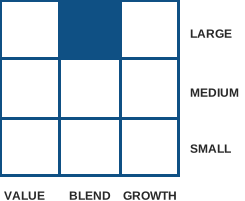
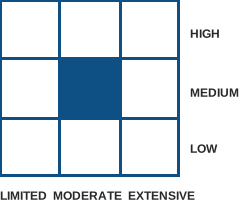
Out of 170 funds

Out of 170 funds

Out of 168 funds
Out of 140 funds
m1. For each fund with at least a three-year history, Morningstar calculates a Morningstar RatingTM based on a Morningstar Risk-Adjusted Return measure that accounts for variation in a fund's monthly performance(not including the effects of sales charges, loads, and redemption fees), placing more emphasis on downward variations and rewarding consistent performance. Exchange traded funds and open-ended mutual funds are considered a single population for comparative purposes. The top 10% of funds in each category receive five stars, then next 22.5% receive four stars, the middle 35% receive three stars, the next 22.5% receive two stars, and the bottom 10% receive one star. The Overall Morningstar RatingTM for a fund is derived from a weighted average of the performance figures associated with its three-, five- and 10-year (if applicable) Morningstar RatingTM metrics. The rating formula most heavily weights the three year rating, using the following calculation: 100% three-year rating for 36-59 months of total returns, 60% five-year rating/40% three-year rating for 60-119 months of total returns, and 50% 10-year rating/30% five-year rating/20% three-year rating for 120 or more months of total returns. Past performance does not guarantee future results.
| Turnover Ratio (%) (annualized) | 5 |
| Sharpe Ratiob54 (3y) | 1.25 |
| Best 2-month Period | Apr. 20 - Jun. 20 | 16.82 |
| Worst 2-month Period | Jan. 20 - Mar. 20 | -17.60 |

This investment has shown a relatively moderate range of price fluctuations in the past. For this reason, it currently lands in the middle third of all investments with records of at least three years. However, this investment may experience larger or smaller price declines or price increases depending on market conditions. To offset some of the investment's risk, investors may wish to own investments with different portfolio makeups or investment strategies.
 PRINTABLE